
Critical Heritage, African Diaspora Archaeology and the Moment When My Eyes Were Opened.

I am a blogger. Blogging has become an extension of how I process complex thoughts and ideas. Composing a blog entry is like creating a work of art, allowing me to release myself from the constraints of academic boundaries and just write my inner thoughts and feelings in ways that are liberating and therapeutic.

So, this entry is about a recent shift in the way I think about the archaeology that I do, the methods I employ to engage with multiple stakeholders, and the ability to compare my experiences across time and space. This all started when I began to notice that many of the archaeologists around me were starting to talk about this thing called heritage.  I presented a paper at an annual conference sponsored by the UMass Amherst Center for Heritage and Society (CHS) about the recent trends in African Diaspora archaeology. I had incredible exchanges with heritage professionals, archaeologists from around the globe who were using unfamiliar language like tangible and intangible heritage, polylogues (as opposed to monologues), and concepts like sites as extensions of public value. I was shocked to learn how different this new heritage differed from my archaic understanding of what heritage was. It was no longer simply the idea of preservation, the built environment, or a tool for nation building, it was about all people, even those who were often marginalized, neglected and underrepresented.

My formal relationship with CHS began when I became a part of a larger project on Eleuthera, an outer island in the Bahamas. Initiated by a local organization, One Eleuthera Foundation (http://oneeleuthera.org/), CHS became a partner in an effort to identify projects and opportunities to “strengthen Eleuthera’s communities and further the economic, environmental and social development of the island” (http://oneeleuthera.org/). This partnership, already going on for a year, involved community engagement, focus groups with a variety of stakeholders, and historical research. There were several viable components to the project, one of which was the possibility for some archaeology of an abandoned 500 acre plantation on the southern tip of the island. I was drawn by the lure of plantation archaeology outside of the Southern United States. However, I quickly discovered that this trip was not about me initiating excavations at Millars plantation, this thing I now know as critical heritage opened my eyes to see realities of lived experience that had to be addressed before a single shovel or trowel ever touched the dirt.

What I found was an island that did not benefit from constantly docking cruise ships or “all inclusive” resorts scattered across the landscape. I found an island impacted by severe un/underemployment, the invisibility of a Haitian labor class, the negative imprint of failed tourism, steady outward migration, and the political and social involvement of second-home owners. I arrived thinking I was there to help the “community,” without knowing what that really meant. Eleutherans were easy to talk to, I learned a great deal about history, family, connection, in many ways I felt like I was returning to a home I had longed for, but never knew existed. The people looked like me, I could relate to the frustrations of the empty promise of tourism and how it fostered apathy in the minds of young people. I was not the archaeological expert, standing in the center of town as an empty vessel to be used to recuperate the buried past. My role was seeing myself as a facilitator between the elder and the youth, the Eleutheran and the Haitian laborer, the community organizer and the second-home owner. The fading history of the island was held close by those who stayed, those who looked to heritage as the means for a sustainable collective memory. Archaeology could tell a story that chronicles the history of an abandoned plantation, the experiences of post-emancipation life, and possibly provide a narrative that can be powerful enough to reclaim a fading Eleutheran identity, but this project was more about dialogue, about reaching a larger audience on and off of the island. As one informant said plainly, “we need you to help remind us all that we have, because we are sitting on it and take it for granted” (Roderick Pindar, personal communication, 2012). And then I went back home, to Western Massachusetts.

On my return I was invigorated and confused. I had to process the trip, knowing that Eleuthera was forever in my system. I had just scratched the surface on my first trip and I continued to delve, very slowly, into this thing called heritage. It was some months later as we were conceptualizing the 2012 UMass Amherst Heritage Archaeology Field School (http://umassheritagearchaeology.com/), that it struck me. I was starting to see my current site, the W. E. B. Du Bois Homesite, differently. I began to think critically about how I had been defining “community” in Great Barrington. Who were we trying to reach through our interpretation and archaeology? I wanted to employ the idea of local and associated stakeholders, mark the contrast and follow where it took us. I was reminded of how Anna Agbe-Davies articulated the reality that many historical archaeologists enter into engagement with very weak theoretical understandings of community (Agbe-Davies, 2010). And then I had one conversation that would again shift the very foundation of my thinking.

That “local” community I was searching for was not as distant as I had imagined. They were witnesses to a transformed landscape that no longer reflected their generational memories. There was a sense of disconnect from what Great Barrington had become and there was a sense of loss and apathy. Although, it does not involve an African descendant community, in the traditional sense, the Du Bois Homesite is surrounded by a rural, descendant group of people that are not invested in the site that occupies a space in their neighborhood. This local community has experienced a steady outward migration of young people, a politically and socially active second-home owner community, the effects of New England seasonal tourism, and massive un/underemployment. The needs of this local community are different than I initially expected or even considered. This community did not look like me, we didn’t share a collective past, but there is a need for their voices to be a part of the dialogue of how we understand the Du Bois Homesite. Therefore, I am beginning to see the possibility of facilitating a conversation, developing a longer relationship to the site and its surroundings and expanding the story/narrative of life in Great Barrington, in the past, present and future.

From critical heritage I have learned that I am no longer just the expert. I have learned that I can serve as a facilitator for the needs of local and associated communities, use an archaeology that includes dialogues that exposes students to the complications of human interaction and conflict. And how these messy situations can become teaching moments, the means to create sustainable relationships between communities and sites, and how, for the first time in my career, my ability to put those lofty theoretical ideas I have about engagement into practice. Whether it is on an outer island in the Bahamas or a small, plot of land on the South Egremont Plain in rural Western Massachusetts, critical heritage has opened my eyes wide enough to see a lasting value in the work that I to do.

  • Agbe-Davies, Anna
    • 2010 “Concepts of community in the pursuit of an inclusive archaeology,” In International Journal of Heritage Studies 16(6):373-389.
  • Pindar, Roderick
    • 2012 Personal Communication, Governor’s Harbor, Eleuthera, Bahamas.

Teaching, public archaeology, and miscellaneous intersections

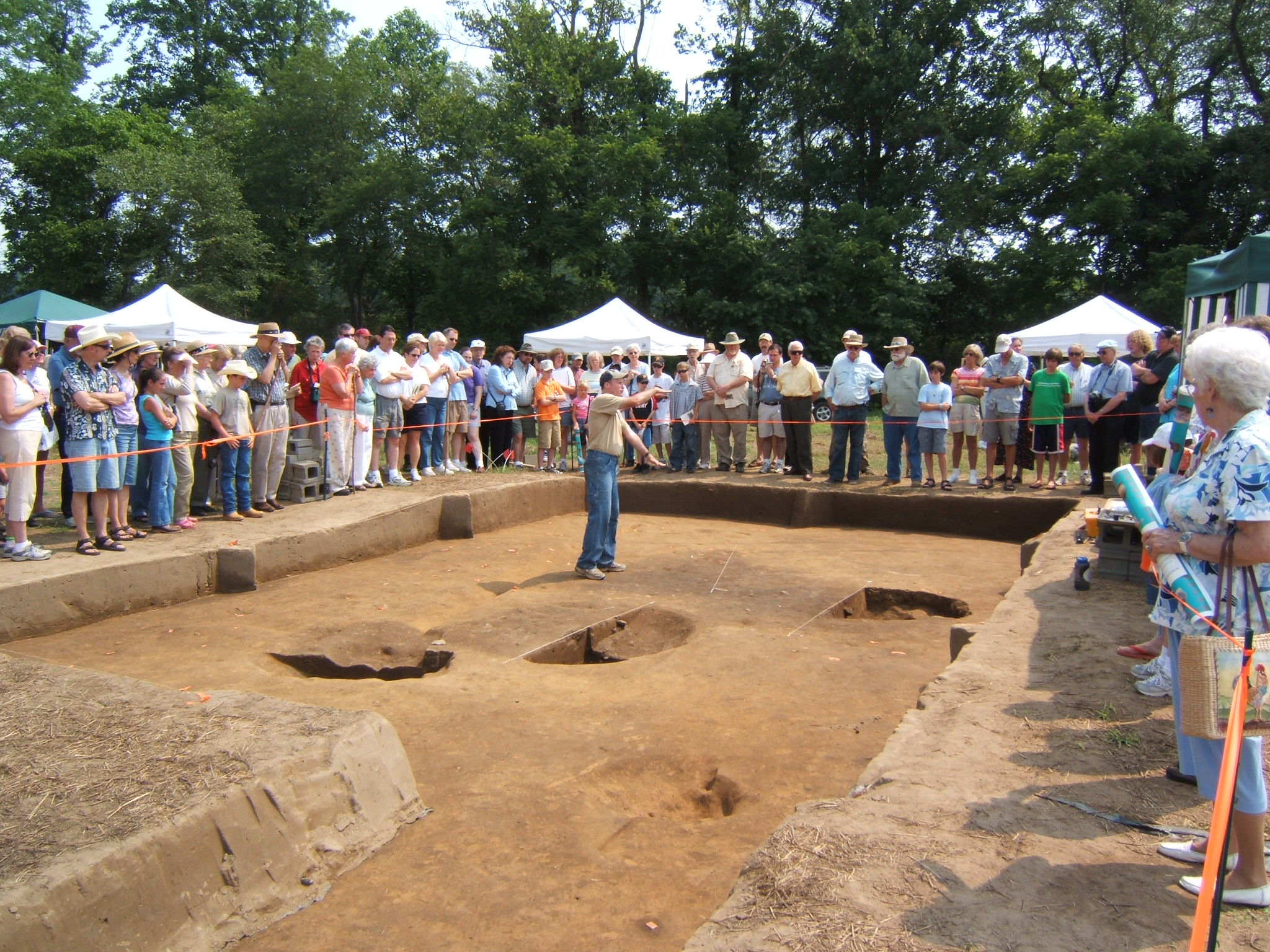
Having just yesterday finished up my teaching of a 6 week archaeology field school, it’s still hard to get my thoughts off of it, or to refocus on strictly public archaeology issues. But as I think about it, the two topics are not so separate. Our field school, offered by the University of Kentucky Department of Anthropology, was held at the Shaker Village of Peasant Hill, Kentucky (www.shakervillageky.org). This is an extremely public site visited by many tourists, and our excavations were located right in the center of the village. This exposure provided a unique opportunity to engage students in public archaeology and to provide the public with a chance to see how Pleasant Hill changed over time.

Large groups on a tight time frame often peered over a fence at us (or we would run over and give them a “quick explanation”), but more leisurely non-group tourists would stop by to see what we were doing. The students were encouraged to speak freely with the visitors and explain our research goals of pinpointing the location of the 1810 Meeting House and the 1812 Centre Family Dwelling, investigating their spatial relationships and the extent to which they lined up with one another and contributed to the sense of order at the village. As an instructor, I found it gratifying to hear the students seriously repeating to the visitors the very ideas I thought had been going right over their heads as I instructed. On the last day of the field school, Morgan, one of our students, was so affected by the experience that she applied for and has been accepted as a future interpreter at the Shaker village site. This was a first for me, and while it may be a loss for us in our stock of trained excavators, it was an unusual win for public archeology in the broader sense!

Our work this summer had another unexpected public component. Once we verified that the foundation of the 1812 Centre Family Dwelling House was fairly well intact not far from the present surface grade, we added a goal of completely exposing this foundation for permanent viewing. This was extra work (not a small task, the Dwelling House main block was 56.25 ft x 45 ft), since our initial research objective could have been met by just exposing and mapping the two front corners of the building, and then backfilling. But by exposing the full foundation, we hoped to give the visitors a better sense that Pleasant Hill had changed drastically over time, and that it had a dynamic history of experimentation as it developed.

Our two buildings sites readily presented this opportunity as they were oriented to a north-south road, an orientation that was abandoned just a few years after completion of the 1812 Centre Family Dwelling. Realignment of the main village 90 degrees to east-west entailed building a new Meeting House (in 1820) and a new Centre Family House (begun in 1824), both of which are standing today within viewshed of our sites, making their strong testimony to the change of orientation. Coupled with this was the fact that the foundation we were excavating was just yards from where most visitors entered the site, making it a unique opportunity to get them thinking about all those other buildings that used to be at Pleasant Hill. Work progressed well to expose the foundation, but we could soon see that the foundations stones were preserved at many different levels, some just below the present surface grade (established in the 1970s to smooth over an overwise rough building ruin), and others up to a foot below the present grade. These deeper areas created a potential hazard for falls, sprained ankles, etc (Shaker Village has overnight guests who do walk about at night) and an obstacle for lawn maintenance. As we pondered our dilemma, Shaker Village staff member Don Pelly came up with an idea — if we could gradually “feather” down the grade in most areas, starting about a foot and a half out from the foundation to gradually lower down to meet the intact foundation stones, the hazard and maintenance burden would be sufficiently reduced. We coined the term “archeolandscaping” to help ease the burden of this work; I think throwing our new term around helped boost our spirits for say, at least a couple of hours!! Several days of work was required but thanks to the students’ efforts, the 1812 Centre Family Dwelling foundation now has a good chance to remain exposed, working to enhance the visitor experience.

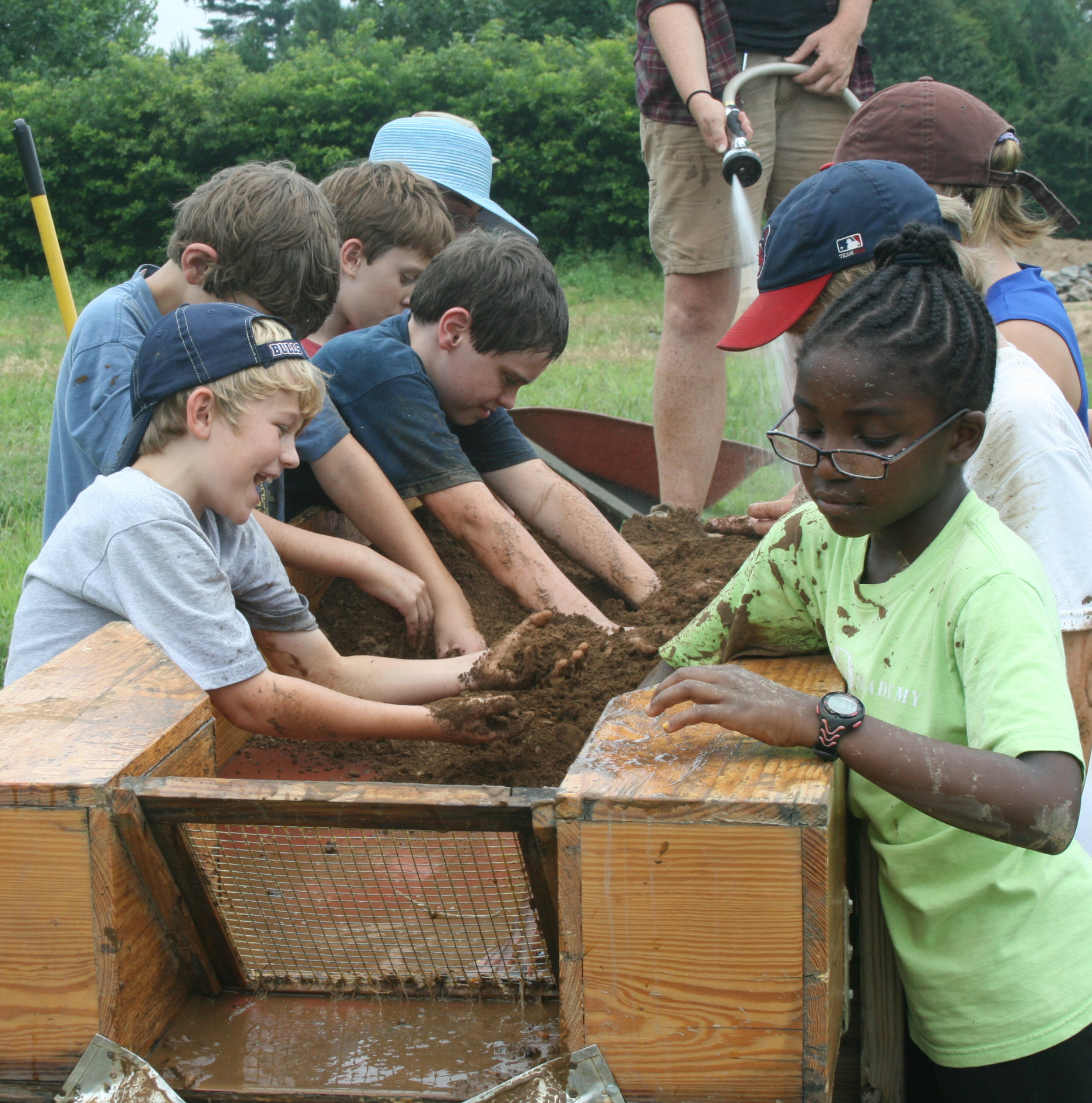
And finally, I was thinking that while these aspects of our experience were very important, still most important, especially as an influence in public archaeology, were the three days we left the Shaker site and journeyed a short distance to the Civil War site of Camp Nelson, in Jessamine County, Kentucky (www.campnelson.org) to assist archaeologist Dr. Stephen McBride in that site’s annual “School Days” program, where all the 5th grade classes of Jessamine County come to Camp Nelson and watch or participate in various reenactor and hands-on history stations, including an archaeology station (often cited as one of the most popular by students and teachers). This year’s archaeology station was excavation at one of the Camp Nelson’s sutler stores. Normally the archaeology station is run by three to four archaeologists, but with the help of the 14 student field school we had a great teacher to student ratio. I was struck by the insightful comments our field school students wrote in their journals (required for the class) after the experience. Though many commented about how tiring it can be to work with large numbers of 5th graders (who would not agree?), they also commented on how exciting it was to watch the amazement of the 5th graders as they connected with material culture not touched by others for nearly 150 years.   Several commented on how important it was to give these young students a sense that history can be discovered in multiple ways, not just in books, to help them better understand the significance of their own local history, or to help them grasp the fragility of archaeological deposits. I was also struck by what a great job our students did in instructing on things like keeping unit floors flat or artifacts in place, even though they had only a couple weeks of experience behind them.

From our experience, it seems as if there is nothing to reinforce learning like being forced to instruct. Have you had similar experiences by exposing your field school students to public archaeology? What strategies do you use to teach your field school students about working with the public? What advantages and disadvantages come from doing public archaeology in a field school setting?

Primary Archaeology data for non-archaeologists?

This post is part of the May 2012 Technology Week, a quarterly topical discussion about technology and historical archaeology, presented by the SHA Technology Committee. This week’s topic examines the use and application of digital data in historical archaeology. Visit this link to view the other posts.

Is there value in exposing archaeological primary data to non-professional audiences? Can online archaeology databases serve broader goals? Can they both inform and serve as a tool for advocacy at time when the practice of archaeology is again being challenged in popular culture?

The National Park Services museum.nps.gov.

The National Park Service website, museum.nps.gov, is the online face of ICMS, the database tool that the Department of the Interior uses to manage its collections. In pre-launch testing the most common reaction was surprise that the parks actually had collections. Individual parks decide what to present on the website and it currently includes nearly 450,000 records, representing over four million objects, half of which are archaeological. Some information is removed before it reaches the web. Crucially for archaeology, this includes site name, site location, within-site provenience and UTM data; excluded to protect sites from the very real threat of looting, and at the request of Native American groups.

But stripping the artifacts of physical context before they reach the web is problematic at best for archaeology, so an attempt has been made to restore some contextual information. Collection highlights were developed to be used by the park staff to allow the grouping of objects, creating a virtual context that can represent a physical space – a site or an archaeological feature – or a thematic context, or a virtual exhibit. Fort Vancouver National Historic Site has created several highlights, including The Fort Vancouver Village. The highlight includes narrative text to explain the complex cultural landscape and is supported by 32 selected artifacts. Those artifacts are hyper-linked to the over two hundred thousand records which are part of Fort Vancouver’s online collection. I’d argue that even if most visitors never look at those records. they need to know that they are there. The National Park Service doesn’t just have great scenery, they have curated over forty million cataloged objects.

At Mount Vernon, George Washington’s Virginia plantation along the Potomac River, The South Grove midden excavation uncovered more than 60,000 artifacts. These represent almost 400 ceramic and glass vessels, hundreds of pounds of brick, mortar, and plaster fragments from renovating buildings, buckles, buttons, tobacco pipes, and more than 30,000 animal bones. A new website (in progress at www.mountvernonmidden.com) focuses on 400 objects, but the full database is there (and available on the Digital Archaeological Archive of Comparative Slavery site) and items are presented in the context of the wider collection. Additionally, the website includes a timeline, a map of the site in relation to the broader plantation landscape, historical notes and related published papers, and a database of the Washington family Invoices and Orders – all part of the larger data set that comprises the project.

So site databases, like the truth, need to be out there. Showing artifacts to the public, without this data-rich environment, suggests that just a few objects have primacy, elevating the qualitative over the quantitative. And if archaeologists want support for the process of archaeology and for digital preservation, then showing the volume of data makes sense.

The problem of exposing the soft underbelly of archaeological data is that at least some members of the public might start to question what’s presented. Why is it so hard to compare one site with another? Why are different methodologies used at different sites? Why does every project record different information? Why does the terminology differ between sites? There is a slow move forward in addressing all these issues (Kansa et al. 2011), but if archaeologists want to hammer home the point that pot hunting and looting are bad, then they should be willing to present and rationalize the datasets that professional archaeologists creates.

I’m not suggesting that advocacy is the only reason to show data. As text books and other electronic publications slowly transition from electronic copies of physical books into fully interactive media, perhaps they’ll also start to include accessible databases, and not just as appendices. Database could support graphs and result sets, allowing data to be manipulated, examined and even challenged. Perhaps eventually these datasets could be more than just one-way presentations of data. On websites, by recording the questions asked of the data, by tracking the datasets produced, these databases might come to be a part of research as well as publication.

References Cited