

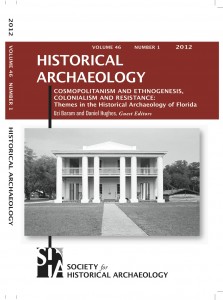
Historical Archaeology 46(1): New Journal and New Design!

The new issue of Historical Archaeology, the Society for Historical Archaeology’s academic journal, 46(1) is hitting your desks and is certain to catch your attention.  This is the first in a new generation of the journal that features a glossy color cover with the contents listed on the back for easy reference.  But it deserves your attention for more than that. This thematic issue compiled by Uzi Baram and Dan Hughes looks at ethnogensis and other topics through the lens of the many cultures of Florida, and explores the ways in which archaeological and historical research can reveal the way the multiple cultural identities of Florida were created, negotiated, and reformed.  Baram and Hughes’ Introduction, attached, gives you a sense of the historical archaeology of Florida and the contents of this issue, which is one you won’t want to miss.
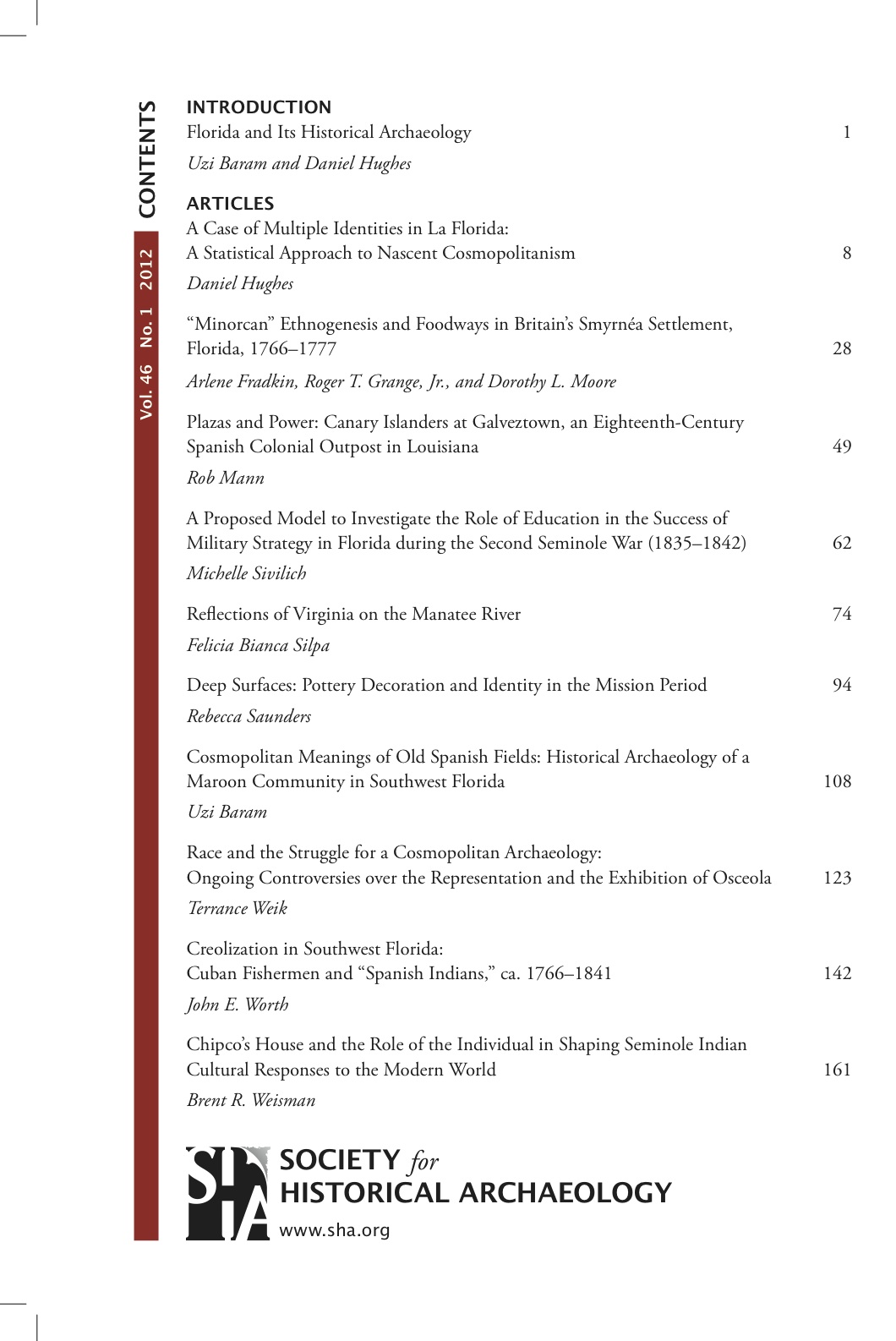
Download Baram and Hughes’ introduction to Historical Archaeology 46(1), Florida and its Historical Archaeology, for free here.

To receive Historical Archaeology quarterly, consider becoming a member of the Society for Historical Archaeology. 

Teaching, public archaeology, and miscellaneous intersections

Having just yesterday finished up my teaching of a 6 week archaeology field school, it’s still hard to get my thoughts off of it, or to refocus on strictly public archaeology issues. But as I think about it, the two topics are not so separate. Our field school, offered by the University of Kentucky Department of Anthropology, was held at the Shaker Village of Peasant Hill, Kentucky (www.shakervillageky.org). This is an extremely public site visited by many tourists, and our excavations were located right in the center of the village. This exposure provided a unique opportunity to engage students in public archaeology and to provide the public with a chance to see how Pleasant Hill changed over time.

Large groups on a tight time frame often peered over a fence at us (or we would run over and give them a “quick explanation”), but more leisurely non-group tourists would stop by to see what we were doing. The students were encouraged to speak freely with the visitors and explain our research goals of pinpointing the location of the 1810 Meeting House and the 1812 Centre Family Dwelling, investigating their spatial relationships and the extent to which they lined up with one another and contributed to the sense of order at the village. As an instructor, I found it gratifying to hear the students seriously repeating to the visitors the very ideas I thought had been going right over their heads as I instructed. On the last day of the field school, Morgan, one of our students, was so affected by the experience that she applied for and has been accepted as a future interpreter at the Shaker village site. This was a first for me, and while it may be a loss for us in our stock of trained excavators, it was an unusual win for public archeology in the broader sense!

Our work this summer had another unexpected public component. Once we verified that the foundation of the 1812 Centre Family Dwelling House was fairly well intact not far from the present surface grade, we added a goal of completely exposing this foundation for permanent viewing. This was extra work (not a small task, the Dwelling House main block was 56.25 ft x 45 ft), since our initial research objective could have been met by just exposing and mapping the two front corners of the building, and then backfilling. But by exposing the full foundation, we hoped to give the visitors a better sense that Pleasant Hill had changed drastically over time, and that it had a dynamic history of experimentation as it developed.

Our two buildings sites readily presented this opportunity as they were oriented to a north-south road, an orientation that was abandoned just a few years after completion of the 1812 Centre Family Dwelling. Realignment of the main village 90 degrees to east-west entailed building a new Meeting House (in 1820) and a new Centre Family House (begun in 1824), both of which are standing today within viewshed of our sites, making their strong testimony to the change of orientation. Coupled with this was the fact that the foundation we were excavating was just yards from where most visitors entered the site, making it a unique opportunity to get them thinking about all those other buildings that used to be at Pleasant Hill. Work progressed well to expose the foundation, but we could soon see that the foundations stones were preserved at many different levels, some just below the present surface grade (established in the 1970s to smooth over an overwise rough building ruin), and others up to a foot below the present grade. These deeper areas created a potential hazard for falls, sprained ankles, etc (Shaker Village has overnight guests who do walk about at night) and an obstacle for lawn maintenance. As we pondered our dilemma, Shaker Village staff member Don Pelly came up with an idea — if we could gradually “feather” down the grade in most areas, starting about a foot and a half out from the foundation to gradually lower down to meet the intact foundation stones, the hazard and maintenance burden would be sufficiently reduced. We coined the term “archeolandscaping” to help ease the burden of this work; I think throwing our new term around helped boost our spirits for say, at least a couple of hours!! Several days of work was required but thanks to the students’ efforts, the 1812 Centre Family Dwelling foundation now has a good chance to remain exposed, working to enhance the visitor experience.

And finally, I was thinking that while these aspects of our experience were very important, still most important, especially as an influence in public archaeology, were the three days we left the Shaker site and journeyed a short distance to the Civil War site of Camp Nelson, in Jessamine County, Kentucky (www.campnelson.org) to assist archaeologist Dr. Stephen McBride in that site’s annual “School Days” program, where all the 5th grade classes of Jessamine County come to Camp Nelson and watch or participate in various reenactor and hands-on history stations, including an archaeology station (often cited as one of the most popular by students and teachers). This year’s archaeology station was excavation at one of the Camp Nelson’s sutler stores. Normally the archaeology station is run by three to four archaeologists, but with the help of the 14 student field school we had a great teacher to student ratio. I was struck by the insightful comments our field school students wrote in their journals (required for the class) after the experience. Though many commented about how tiring it can be to work with large numbers of 5th graders (who would not agree?), they also commented on how exciting it was to watch the amazement of the 5th graders as they connected with material culture not touched by others for nearly 150 years.   Several commented on how important it was to give these young students a sense that history can be discovered in multiple ways, not just in books, to help them better understand the significance of their own local history, or to help them grasp the fragility of archaeological deposits. I was also struck by what a great job our students did in instructing on things like keeping unit floors flat or artifacts in place, even though they had only a couple weeks of experience behind them.

From our experience, it seems as if there is nothing to reinforce learning like being forced to instruct. Have you had similar experiences by exposing your field school students to public archaeology? What strategies do you use to teach your field school students about working with the public? What advantages and disadvantages come from doing public archaeology in a field school setting?

Too Historic To Fail

Have you had an opportunity to read the latest chapter in the depressing Carter’s Grove saga?

Carter’s Grove, for those beyond the Mid-Atlantic, is a mid-18th-century James River plantation house that is also the site of Martin’s Hundred, one of the settlements attacked by the Powhatan in 1622 and discovered and excavated by Ivor Noël Hume. The property was owned by the Colonial Williamsburg Foundation (CW) and operated as one of the Foundation’s ticketed sites until 2003, when poor visitation numbers led to its closure.

In 2006, Carter’s Grove was sold by CW to Halsey Minor, an internet technology entrepreneur, for more than $15 million; CW held the note. Minor has since stopped paying the mortgage and declared bankruptcy to avoid foreclosure. The case is now in United States Bankruptcy Court in Norfolk.

Carter’s Grove. Photo via Flickr user roger4336 via Creative Commons License.

The Washington Post recently ran a story about the situation. The comments are fascinating (as only comments in the digital age can be). Most people mock Halsey Minor, mercilessly so, blaming him for what is happening to Carter’s Grove and looking forward to his pending comeuppance from the bankruptcy court judge.

A fair number, however, blame CW. Jtrice12 wrote that CW “should be ashamed for selling the place to someone with no expertise in historical preservation… They’ll never get another penny of my money.” “Astoundingly poor management,” concurred Doctor_Dru. CW “sold off Carter’s Grove instead of fulfilling [its] core mission,” PBrown448 declared, and so “off with the [CW] trustees[’] heads!”

The Carter’s Grove situation reveals the challenges facing organizations everywhere which manage historic sites. It also reveals how the challenge of sustainability extends beyond historic houses to archaeological properties (like Martin’s Hundred) and to the reconstructions / replicas often built to re-imagine these places on the landscape. Typically, reconstructions and other types of archaeological site interpretation can still require an infrastructure that includes not just visitor amenities but the expertise of archaeologists and educators. These are not inexpensive propositions.

Joan Poor, an environmental economist, has convinced me that cultural economics is an under-utilized tool for informed decision-making about the investment in and sustainability of historic properties. Cultural economics is concerned with the application of economic analysis to, among other things, the heritage and cultural industries (Towse 2010; see also the Journal of Cultural Economics). Poor believes that a public archaeology would not only benefit from a perspective rooted in cultural economics, but demands it.

Poor’s research in southern Maryland focuses on the analysis of historic sites as public goods, and just how much people are willing to pay to support them. Using the methods of cultural and natural resources economics, Poor works to establish values for historic and preservation attributes which cannot be measured in the private market. She has found that most people are indeed willing to support historic sites through tax dollars as well as through visitation (Poor and Smith 2004).

This willingness, however, has its limits. Poor suggests that site managers can find these limits through economic analysis and then develop realistic plans for the management of historic properties, including, if necessary, the conversion of a public good into a private good, such as selling a historic house.

Poor also argues that willingness-to-pay is not some forever fixed number, and that knowing the public’s limits can lead to the development of longer-term strategies for educating the public and, ultimately, increasing willingness-to-pay.

Unlike standing structures, archaeological sites don’t often need new roofs, paint jobs, or insurance. Still, there are real infrastructural costs for their preservation, accessibility, and interpretation. Cultural economics may provide yet another measure for determining the sustainability of various strategies for managing archaeological sites.

I have been thinking about Poor’s comments a lot lately because I am getting the sense that the rotten economy is masking a larger transformation in the public’s attitudes and support of historic preservation, especially archaeological sites. On the one hand, many surveys suggest that the public has never been more aware of and supportive of archaeology (see, for example, Ramos and Duganne 2000); on the other, a number of archaeology programs are on the chopping block, from museums to universities to government (none more draconian than what has been proposed for Parks Canada [read the SHA response to these cuts]). It’s not clear whether these proposed cuts reflect cost-saving measures or something else altogether. An analysis based in cultural economics might help tease out issues of a recession-induced inability to pay versus a declining willingness-to-pay.

Are there lessons we can take away from the Carter’s Grove debacle? Are we entering a new phase in the public support of archaeology? How can archaeological projects (a term used here broadly) be sustainable projects?

I am grateful to Dr. Joan Poor, Provost, Truman State University, for introducing me to the importance of cultural economics and inviting my participation in her project at Point Lookout State Park near Scotland, Maryland.

  • Ramos, Maria, and David Duganne
  • Poor, P. Joan, and Jamie Smith
    • 2004  Travel Cost Analysis of a Cultural Heritage Site: The Case of Historic St. Mary’s City.  Journal of Cultural Economics 28:217-229.
  • Towse, Ruth
    • 2010   A Textbook of Cultural Economics. Cambridge University Press.

[Image courtesy of Flickr user roger4336 via Creative Commons License]